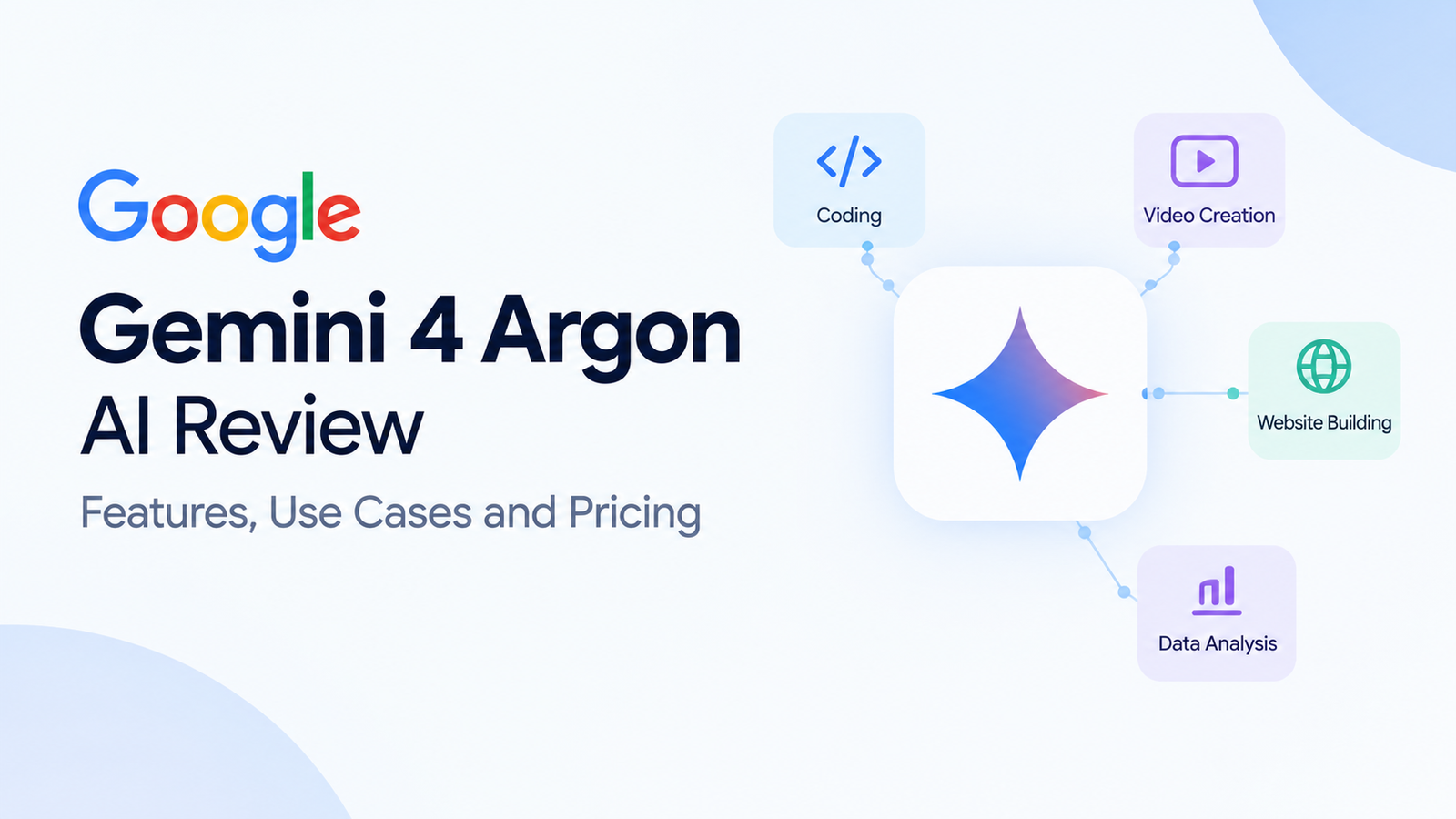
Artificial intelligence is changing how people create content, develop websites, analyze information, and automate complex tasks. From generating realistic product videos to building interactive website prototypes, modern AI tools are becoming increasingly useful for creators, developers, marketers, and businesses.
Google Gemini 4 Argon is presented in the reviewed material as an advanced AI model designed to handle complex, multi-step tasks. The review highlights several impressive demonstrations, including 3D game creation, video generation, website development, spreadsheet analysis, and document reconciliation.
But how much of this technology is genuinely useful? Can it create websites from simple prompts? Does it generate videos directly? Is it free for everyone?
In this article, we examine the features and demonstrations described in the video review, explain their practical applications, and highlight important limitations related to access, pricing, and accuracy.
What Is Google Gemini 4 Argon AI?
Google Gemini 4 Argon is described in the supplied review as a frontier AI model designed for demanding tasks that require advanced reasoning, long-context understanding, and assistance across multiple professional fields.
According to the document, its intended applications include software development, financial research, legal drafting, cybersecurity, and enterprise knowledge work.
Unlike an AI assistant used only for answering simple questions, the model is presented as a tool for working through detailed instructions, analyzing large amounts of information, and producing practical outputs.
Key Features of Gemini 4 Argon
The review highlights the following capabilities:
- Large context window: A claimed context capacity of up to one million tokens.
- Advanced coding assistance: Support for programming, debugging, and software development tasks.
- Multimodal input: Processing text, images, audio, video, and PDF documents, as described in the supplied material.
- Data analysis: Examining datasets, calculating metrics, and identifying possible explanations for changes.
- Document analysis: Comparing multiple documents and identifying conflicting statements.
- Creative workflows: Working with Gemini tools to support website prototypes and video-related tasks.
These features could be valuable for professionals who need to work with lengthy documents, complex instructions, or several types of information in a single workflow.
However, the exact product name, model specifications, current availability, and pricing should be checked against official Google documentation before relying on them.
Top 5 Google Gemini 4 Argon AI Use Cases
The reviewed video demonstrates five major use cases. Each example illustrates how AI can assist with a different type of creative or analytical task.
1. Creating a 3D Game With AI
One of the most interesting demonstrations involves turning an ordinary desk image into a playable wizard chess game.
The concept is straightforward: instead of manually designing every asset, writing all the game logic, and creating a visual environment from scratch, the user provides a detailed prompt and lets the AI-assisted workflow generate an initial prototype.
The demonstration described in the report includes a chessboard, game assets, rules, and a three-dimensional visual environment.
How AI Game Creation Can Help
AI-assisted game development may help beginners and developers with:
- Creating early game concepts and prototypes.
- Generating ideas for characters, environments, and objects.
- Writing initial game logic and rules.
- Exploring different visual styles.
- Reducing the time required to test an idea.
For example, an independent developer could start with a prompt describing a fantasy chess game and use the resulting prototype to explore its mechanics before investing time in a complete game.
However, generating a prototype does not necessarily mean producing a finished, production-ready game. Performance, gameplay balance, compatibility, and security may still require manual development and testing.
2. Generating Realistic Product Videos
The second demonstration focuses on AI-assisted video creation.
The prompt described in the review asks for an eight-second product video featuring a white ceramic coffee mug with a red handle, steam rising from the mug, and warm morning light.
The resulting clip is presented as a realistic product-style video.
Benefits for Content Creators and Marketers
AI-assisted video workflows could be useful for:
- Creating product advertisements.
- Developing short-form social media content.
- Producing visual concepts for campaigns.
- Testing different lighting and composition ideas.
- Creating preliminary promotional assets.
Small businesses and independent creators may benefit from generating visual concepts before arranging a traditional product shoot.
For instance, an online store selling coffee accessories could use AI-generated concepts to explore different backgrounds, product placements, and lighting conditions.
An important technical distinction: The supplied report attributes video rendering to a specialized Gemini video workflow called Gemini Omni, rather than to the Argon text API directly. Therefore, the demonstration should not be interpreted as proof that the model’s API independently generates video files.
Users should also review generated footage for visual inconsistencies, product accuracy, and commercial-use requirements.
3. Building a Website With Gemini Canvas
Website development is another major use case discussed in the review.
The example involves creating a one-page website for a fictional pottery workshop called “Clay Saturday.” The prompt specifies a warm cream colour palette, workshop cards, pricing, class-level filters, and a booking form.
According to the supplied report, Gemini Canvas produced a website prototype with HTML, CSS, and JavaScript functionality.
What Can an AI Website Builder Create?
Depending on the tool and the quality of the prompt, AI-assisted website development may help create:
- Landing pages for digital products.
- Portfolio websites for designers and photographers.
- Product and service presentation pages.
- Booking-form prototypes.
- Pricing tables and service cards.
- Responsive page layouts.
- Initial website code for further customization.
For example, a freelance designer could describe a portfolio website containing a hero section, project gallery, service list, testimonials, and contact form. An AI tool could help generate the initial structure and code.
Can AI Build a Complete Website?
AI can accelerate website prototyping, but a generated page should not automatically be considered a complete business website.
Before publishing, users should check:
- Whether forms actually submit data.
- Whether payment and booking systems work correctly.
- Whether the design adapts to mobile devices.
- Whether user information is handled securely.
- Whether the site meets accessibility and performance requirements.
- Whether hosting, domain, and backend integrations are configured.
AI-generated code can be a useful starting point, but professional review remains important for websites that handle customer information or payments.
4. Analyzing Data and Understanding Conversion Rates
The fourth demonstration explores spreadsheet and CSV analysis.
The example describes a website that experienced an overall conversion-rate decline following a redesign. The AI assistant examines conversion rates for new and returning visitors and identifies a possible statistical explanation.
The supplied report gives the following figures:
| Visitor segment | Before | After |
|---|---|---|
| New visitors | 20% | 25% |
| Returning visitors | 30% | 35% |
| Overall conversion rate | 29% | 26% |
In this example, both visitor segments improve while the overall conversion rate falls. The review identifies Simpson’s paradox as a possible explanation.
What Is Simpson’s Paradox?
Simpson’s paradox occurs when a trend observed within separate groups reverses or changes when the groups are combined. This can happen when the relative sizes or proportions of the groups differ between datasets.
For example, a website may receive a larger share of traffic from a lower-converting visitor segment after a redesign. Even if conversion rates improve within each segment, the combined conversion rate could decline.
This is why examining only one overall metric can lead to misleading conclusions.
How AI Can Support Data Analysis
AI-assisted data analysis may help users:
- Summarize large spreadsheets.
- Compare performance before and after changes.
- Calculate conversion rates and percentage differences.
- Identify unusual patterns.
- Suggest hypotheses for further investigation.
- Translate technical findings into understandable explanations.
However, the example’s underlying visitor counts and segment proportions are not reproduced in full in the supplied summary. The reported percentages alone are insufficient to independently verify the exact cause of the overall decline.
Businesses should validate calculations against the original dataset before making decisions about marketing campaigns, website redesigns, or advertising budgets.
5. Comparing Documents and Identifying Conflicts
The fifth demonstration focuses on document reconciliation.
In the example, the AI system receives several documents containing conflicting information about a product launch. It identifies statements that are supported or contradicted by the supplied material and prepares a corrected summary.
The review reports that the model correctly classified seven out of eight labels in this particular exercise.
Practical Applications of Document Analysis
This type of workflow could help professionals working with:
- Business reports and project plans.
- Product launch documents.
- Marketing briefs.
- Meeting notes.
- Policy documents.
- Research reports.
- Multiple versions of the same document.
For example, a marketing team could compare a campaign brief with an updated project report to identify differences in dates, product specifications, deliverables, or launch status.
The key advantage is that an AI assistant can help organize information and highlight contradictions without requiring the user to compare every sentence manually.
Nevertheless, the reported seven-out-of-eight result is specific to the demonstration. It should not be treated as a universal accuracy rate. Important claims should be checked against their original sources, especially when documents affect legal, financial, or operational decisions.
Google Gemini 4 Argon Features Explained
Beyond the five demonstrations, the supplied review highlights several technical characteristics.
One-Million-Token Context Window
The report describes a context window of up to one million tokens.
A context window determines how much information a model can consider within a particular interaction or task, subject to the system’s limits. A large context window may be useful when analyzing long reports, extensive codebases, multiple documents, or lengthy research materials.
However, token capacity does not guarantee that every detail will be interpreted correctly. Users should still provide clear instructions, structure their inputs, and verify important findings.
Multimodal Input Support
The report describes support for text, images, audio, video, and PDFs as inputs.
Multimodal processing can make it possible to combine different forms of information within one workflow. For example, a user might provide a screenshot, a written explanation, and a document to request a structured analysis.
The specific supported formats, file limits, and tool integrations depend on the product or API configuration and should be verified before use.
Coding, Research, and Cybersecurity
The reviewed material presents coding, financial research, legal drafting, and cybersecurity vulnerability patching as important target applications.
These are demanding tasks because they often require more than generating fluent text. They can involve understanding dependencies, checking evidence, applying constraints, and reasoning across multiple steps.
AI assistance may speed up initial analysis and implementation, but outputs still require appropriate testing and expert review. In particular, cybersecurity changes should be tested in controlled environments before being deployed to production systems.
Is Google Gemini 4 Argon Free?
One of the most important questions raised by the review concerns access and pricing.
The supplied report states that access is limited and describes paid Google AI Pro or Ultra subscriptions, along with paid API usage. It also lists introductory API prices of approximately $2 per million input tokens and $10 per million output tokens.
These figures are claims recorded in the supplied document, not independently verified current prices. Subscription eligibility, model availability, quotas, regional restrictions, and API rates can change.
Before purchasing a plan, check the official Google Gemini product information and developer pricing pages.
What Should Users Check Before Paying?
Consider the following points:
- Whether the specific model is available to your account.
- Whether a subscription includes access to the desired features.
- Whether usage limits apply.
- Whether video-generation tools are included separately.
- Whether API usage incurs additional charges.
- Whether the service is available in your country.
- Whether the tool meets your actual project requirements.
Avoid relying on unofficial websites or social media posts that promise free premium upgrades, unlimited access, or promotional codes without credible evidence.
Limitations of Gemini 4 Argon AI
Despite the impressive demonstrations described in the review, several limitations deserve attention.
AI Outputs Can Contain Errors
AI systems may produce inaccurate calculations, unsupported statements, or code that does not behave as expected. Even the document-reconciliation example reports one classification error.
Demonstrations Are Not Guarantees
A successful website prototype or short product video does not establish that every prompt will produce equally good results. Outcomes can vary depending on the task, instructions, input quality, and available tools.
Some Features Depend on Separate Tools
The reviewed video-generation example uses a specialized video workflow. Users should distinguish between the underlying model and the additional tools used to produce a particular output.
Access and Pricing May Be Restricted
The report describes a controlled rollout and paid access. Availability should be checked directly rather than assumed from a video demonstration.
Human Review Remains Necessary
For professional websites, financial decisions, legal documents, and cybersecurity work, human verification is essential. AI should support informed decision-making rather than replace appropriate accountability.
Google Gemini 4 Argon vs Traditional Workflows
The following comparison describes the potential workflow differences, rather than claiming that AI is superior in every situation.
| Task | Traditional workflow | AI-assisted workflow |
|---|---|---|
| Website prototyping | Manual layout and coding | Generate an initial layout and code |
| Product-video concepts | Plan a shoot and create assets | Explore generated visual concepts |
| Spreadsheet analysis | Write formulas and inspect trends | Request calculations and explanations |
| Document comparison | Read and compare documents manually | Identify possible conflicts automatically |
| Game prototyping | Build assets and logic step by step | Generate an initial concept or prototype |
AI-assisted workflows may reduce repetitive work and help users explore ideas faster. However, the final time savings depend on how much editing, testing, and correction the output requires.
Who Can Benefit From Advanced AI Tools?
The use cases discussed in the review are relevant to several audiences.
Content Creators
Creators can explore video concepts, prepare scripts, develop visual ideas, and organize research for articles or social media posts.
Website Designers and Developers
AI-assisted coding can help generate initial page structures, prototypes, and reusable components that developers can review and refine.
Digital Marketers
Marketers can use AI to explore campaign concepts, analyze performance data, and organize research before making strategic decisions.
Students and Researchers
AI can help summarize complex material, compare documents, and explain technical concepts. Users should verify factual claims and follow applicable academic-integrity rules.
Small Business Owners
Small businesses may use AI-assisted tools to develop website prototypes, prepare promotional ideas, and analyze business data without starting every task from scratch.
Frequently Asked Questions (FAQs)
What is Google Gemini 4 Argon AI?
The supplied review describes Gemini 4 Argon as an advanced AI model intended for complex reasoning, coding, research, document analysis, and other demanding workflows. Verify the product’s official name and specifications before relying on these claims.
Can Gemini 4 Argon create a website?
The review describes a Gemini Canvas demonstration that generated a booking website prototype from a detailed prompt. A prototype may still require backend integration, security checks, testing, and deployment work.
Can Gemini 4 Argon generate videos?
The reviewed demonstration uses a Gemini video-generation workflow to create a short product clip. According to the supplied report, the specialized video tool performs the rendering rather than the Argon text API directly.
Does Gemini 4 Argon support data analysis?
The report describes a CSV-analysis example involving visitor conversion rates. AI can help calculate metrics and explain possible patterns, but users should validate results against the underlying data.
Is Gemini 4 Argon free to use?
The supplied document describes paid access and restricted availability. Current eligibility, pricing, and subscription requirements must be confirmed using official Google sources.
Is Gemini 4 Argon always accurate?
No AI output should be assumed to be error-free. The supplied review itself describes a minor error during document reconciliation. Important calculations, factual claims, and code should be independently checked.
Conclusion: Is Google Gemini 4 Argon AI Worth Exploring?
The demonstrations described in the supplied review illustrate how advanced AI workflows can support website prototyping, creative production, spreadsheet analysis, game concepts, and document comparison.
The most valuable idea is not that AI can replace every professional task. It is that a well-designed workflow can help users move from an initial idea to a testable result more quickly.
For content creators, developers, marketers, and business owners, these capabilities are worth investigating when they solve a real problem. However, impressive demonstrations should be separated from verified product specifications, and AI-generated results should be checked before they are used professionally.
Before adopting Gemini 4 Argon, verify the model’s official availability, current pricing, and supported tools. With realistic expectations and appropriate human review, AI can become a useful part of a modern digital workflow.
Editorial note: This article is based on the supplied executive summary and video analysis. Verify product-specific claims and pricing against official documentation before publication.

Digital marketer from Hyderabad. Writing about Telugu cartoons, Ai and tech news at kumar4.in.